



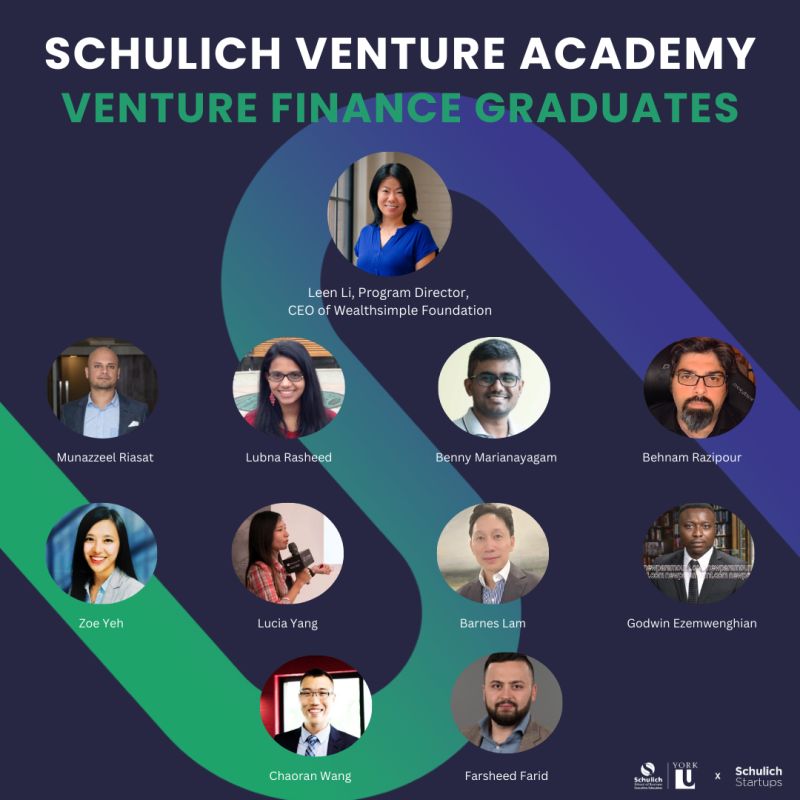
After completing the Treefrog accelerator program, Treefrog introduced me to the Schulich School of Business at York University, where I joined the Venture Finance program.
The program was designed around one of the most critical areas of entrepreneurship: understanding how startups are financed, valued, structured, and prepared for growth and investment. It went far beyond basic financial literacy, focusing instead on how founders should think about capital, risk, fundraising, financial decision-making, and building companies that can scale.
My instructor was Leen Li, former CFO of Wealthsimple and former CEO of the Wealthsimple Foundation. Wealthsimple itself has become one of Canada’s most prominent fintech companies, reaching a valuation of approximately CAD 10 billion and surpassing CAD 100 billion in assets under administration. Learning directly from someone who had helped lead the financial side of a company at that scale gave the course a level of practical depth that is difficult to find in conventional business education.
Many of the concepts I had encountered at Treefrog returned in Schulich, but at a completely different level. Subjects that I had previously understood from the perspective of an early-stage founder were revisited through the lens of venture finance, scale, investment, governance, risk, and long-term company building.
One of the most valuable parts of the program was the entrepreneurs Leen invited into the classroom. Nearly every session brought the opportunity to learn directly from founders and executives who had built, led, or participated in one or more unicorn companies.
Some of them were genuinely prominent figures in the global entrepreneurial ecosystem. Since I am not certain whether I am free to publicly associate their names with the private discussions and experiences shared during the cohort, I prefer not to name them. What mattered most was having access to their thinking: how they evaluated opportunities, how they approached risk, how they handled failure, how they built teams, and how they made decisions when the stakes became very large.
The experience gave me something beyond knowledge: confidence.
It helped me understand that becoming the founder of a multi-billion-dollar company is not necessarily a distant or unrealistic dream reserved for a completely different class of people. The gap between an ordinary entrepreneur and someone capable of building a billion-dollar company is often less mysterious than it appears.
A large part of that gap lies in mindset: the risks a founder is willing to take, the quality of the decisions they make, the people they surround themselves with, and the network of capable and successful individuals they deliberately build around themselves.
I also began to appreciate the importance of honesty, both internally and externally. Honesty about the weaknesses of the company, about the abilities of the team, about what is actually working, and about what only appears attractive from the outside.
The course reinforced another lesson that has stayed with me: there are parts of the entrepreneurial process that should not be skipped.
Trying to find shortcuts around fundamental steps usually creates larger problems later. A founder has to be willing to make uncomfortable decisions, including removing people who no longer add value to the team, avoiding structures that unnecessarily slow the company down, and walking away from opportunities that look impressive from a distance, just like a mirage, but turn out to be empty once examined closely.
These ideas may sound familiar. Most founders have read them in books, heard them in podcasts, or encountered them in countless articles about entrepreneurship.
But there is a significant difference between reading those ideas and entering an ecosystem where people who have actually built companies at that scale are sitting in front of you, explaining the decisions they made, sharing the mistakes they lived through, challenging your assumptions, criticizing your startup, and sometimes offering specific suggestions for how it could become better.
That experience is difficult to translate completely into words.
For me, Schulich was not simply another business course. It was an opportunity to temporarily step inside a different level of the entrepreneurial ecosystem and observe how people operating at that level think.
It changed the scale at which I allowed myself to think about MindXR, and perhaps more importantly, the scale at which I allowed myself to think about what I could eventually become as a founder.
Even now, I sometimes miss the feeling I had during that cohort, the sense of being surrounded by people, ideas, and experiences that constantly pushed the boundaries of what I considered possible.
Behnam Razipour · July 15, 2024